Tourism in Mumbai
is an industry that attracts almost 6 million tourists per year, making it the 30th-most visited location worldwide.[1]With a metro population of approximately 20 million, Mumbai is the largest city in India and the 10th largest city in the world.

Clockwise from top: Cuffe Parade skyline, Taj Mahal Palace Hotel, Chhatrapati Shivaji Terminus, Bandra–Worli Sea Link, and the Gateway of India.
Mumbai offers natural heritage and modern entertainment including leisure spots, beaches, cinemas, studios, holy places, amusement parks and historical monuments. Transport options include air, road, train and ship.
Film studios
The Hindi film industry, often metonymously referred to as Bollywood, is based in Mumbai. It offers major cinemas and is home to more than 20 film studios.
Places to visit





Places to visit
Water activities
Many beaches in Mumbai are open to the general public. Beach locations include:
Additionally, lakeside destinations in Mumbai include:
Transport

The Mumbai Suburban Railwaysystem carries more than 6.99 million commuters on a daily basis. It has the highest passenger density of any urban railway system in the world.

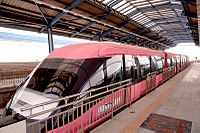
The Mumbai Monorail opened in February 2014.

BEST buses carry a total of 4.5 million passengers daily.

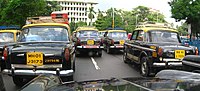
The black and yellow Premier Padmini Taxis are iconic of Mumbai.

The Bandra-Worli Sea Link is a cable-stayed bridge that connects central Mumbai with its western suburbs

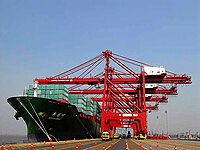
Jawaharlal Nehru Port Trust is the busiest port in India
Public transport
Public transport systems in Mumbai include the Mumbai Suburban Railway, Monorail, Metro, Brihanmumbai Electric Supply and Transport (BEST) buses, black-and-yellow meter taxis, auto rickshaws and ferries. Suburban railway and BEST bus services together accounted for about 88% of the passenger traffic in 2008.[221] Auto rickshaws are allowed to operate only in the suburban areas of Mumbai, while taxis are allowed to operate throughout Mumbai, but generally operate in South Mumbai.[222] Taxis and rickshaws in Mumbai are required by law to run on compressed natural gas (CNG),[223]and are a convenient, economical, and easily available means of transport.[222]
Rail
The Mumbai Suburban Railway, popularly referred to as Locals forms the backbone of the city's transport system.[224] It is operated by the Central Railway and Western Railway zones of the Indian Railways.[225] Mumbai's suburban rail systems carried a total of 6.3 million passengers every day in 2007.[226]Trains are overcrowded during peak hours, with nine-car trains of rated capacity 1,700 passengers, actually carrying around 4,500 passengers at peak hours.[227] The Mumbai rail network is spread at an expanse of 319 route kilometres. 191 rakes (train-sets) of 9 car and 12 car composition are utilised to run a total of 2,226 train services in the city.[228]
The Mumbai Monorail and Mumbai Metrohave been built and are being extended in phases to relieve overcrowding on the existing network. The Monorail opened in early February 2014.[229] The first line of the Mumbai Metro opened in early June 2014.[230]
Mumbai is the headquarters of two zones of the Indian Railways: the Central Railway (CR)headquartered at Chhatrapati Shivaji Terminus (formerly Victoria Terminus), and the Western Railway (WR) headquartered at Churchgate.[231] Mumbai is also well connected to most parts of India by the Indian Railways. Long-distance trains originate from Chhatrapati Shivaji Terminus, Dadar, Lokmanya Tilak Terminus, Mumbai Central, Bandra Terminus, Andheri and Borivali.[232]
Bus
Mumbai's bus services carried over 5.5 million passengers per day in 2008,[221] which dropped to 2.8 million in 2015.[233] Public buses run by BEST cover almost all parts of the metropolis, as well as parts of Navi Mumbai, Mira-Bhayandar and Thane.[234] The BEST operates a total of 4,608 buses[235] with CCTV cameras installed, ferrying 4.5 million passengers daily[221] over 390 routes. Its fleet consists of single-decker, double-decker, vestibule, low-floor, disabled-friendly, air-conditioned and Euro III compliant diesel and compressed natural gas powered buses.[236]BEST introduced air-conditioned buses in 1998.[237] BEST buses are red in colour, based originally on the Routemaster buses of London.[238] Maharashtra State Road Transport Corporation (MSRTC, also known as ST)[239] buses provide intercity transport connecting Mumbai with other towns and cities of Maharashtra and nearby states.[240][241] The Navi Mumbai Municipal Transport (NMMT) and Thane Municipal Transport (TMT) also operate their buses in Mumbai, connecting various nodes of Navi Mumbai and Thane to parts of Mumbai.[242][243]
Buses are generally favoured for commuting short to medium distances, while train fares are more economical for longer distance commutes.[244]
The Mumbai Darshan is a tourist bus service which explores numerous tourist attractions in Mumbai.[245] Bus Rapid Transit System (BRTS) lanes have been planned throughout Mumbai.[246] Though 88% of the city's commuters travel by public transport, Mumbai still continues to struggle with traffic congestion.[247] Mumbai's transport system has been categorised as one of the most congested in the world.[248]
Water
Water transport in Mumbai consists of ferries, hovercrafts and catamarans. Services are provided by both government agencies as well as private partners.[249] Hovercraft services plied briefly in the late 1990s between the Gateway of India and CBD Belapur in Navi Mumbai. They were subsequently scrapped due to lack of adequate infrastructure.[250]
Road
Mumbai is served by National Highway 3, National Highway 4, National Highway 8, National Highway 17 and National Highway 222 of India's National Highways system.[251]The Mumbai-Pune Expressway was the first expressway built in India.[252] The Eastern Freeway was opened in 2013. The Mumbai Nashik Expressway, Mumbai-Vadodara Expressway,[253] are under construction. The Bandra-Worli Sea Link bridge, along with Mahim Causeway, links the island city to the western suburbs.[254] The three major road arteries of the city are the Eastern Express Highway from Sion to Thane, the Sion Panvel Expressway from Sion to Panvel and the Western Express Highway from Bandra to Dahisar.[255] Mumbai has approximately 1,900 km (1,181 mi) of roads.[256] There are five tolled entry points to the city by road.[257]
Mumbai had about 721,000 private vehicles as of March 2014,[258] 56,459 black and yellow taxis as of 2005,[259] and 106,000 auto rickshaws, as of May 2013.[260]
Air

Chhatrapati Shivaji International Airport, Mumbai, India
The Chhatrapati Shivaji International Airport(formerly Sahar International Airport) is the main aviation hub in the city and the second busiest airport in India in terms of passenger traffic.[261] It handled 36.6 million passengers and 694,300 tonnes of cargo during FY 2014–2015.[262] An upgrade plan was initiated in 2006, targeted at increasing the capacity of the airport to handle up to 40 million passengers annually[263] and the new terminal T2 was opened in February 2014.[264]
The proposed Navi Mumbai International Airport to be built in the Kopra-Panvel area has been sanctioned by the Indian Government and will help relieve the increasing traffic burden on the existing airport.[265]
The Juhu Aerodrome was India's first airport, and now hosts the Bombay Flying Club and a heliport operated by state-owned Pawan Hans.[266]
Sea
Mumbai is served by two major ports, Mumbai Port Trust and Jawaharlal Nehru Port Trust, which lies just across the creek in Navi Mumbai.[267] Mumbai Port has one of the best natural harbours in the world, and has extensive wet and dry dock accommodation facilities.[268] Jawaharlal Nehru Port, commissioned on 26 May 1989, is the busiest and most modern major port in India.[269] It handles 55–60% of the country's total containerised cargo.[270] Ferries from Ferry Wharf in Mazagaon allow access to islands near the city.[271]
The city is also the headquarters of the Western Naval Command, and also an important base for the Indian Navy.
Forts and caves
Mumbai’s most significant historical locations include more than 14 forts and 5 naturally-formed caves. A few examples include:

British fort in Mahim, Mumbai


No comments:
Post a Comment